Find the Best Custom Software Development Software Development Companies in 2026 — in Under 60 Seconds

Compare 100s of software development companies.

Evaluate the pros and cons of each company based on your requirements.

Results based on 700+ hours of industry research.

Best Custom Software Development Companies in 2026

1BairesDev

2X-Team

3Fingent

4IFS

5N-iX

6Avenga

7Net Solutions

8Encora

9TekRevol

10TatvaSoft

11Koombea

12iTechArt

13Chetu

14The Software House

15Andersen Inc.

16Hexacta
What Is Custom Software Development?
Custom software development is the process of designing, building, and maintaining software tailored to a specific organization's needs. Unlike commercial off-the-shelf (COTS) products that serve broad markets with standardized features, custom solutions are built around your business processes, workflows, and goals.
The distinction matters because off-the-shelf software forces your business to adapt to the tool. Custom development adapts the tool to your business. When your competitive advantage depends on unique processes, proprietary data handling, or customer experiences that differentiate you from competitors, custom software is how you protect and extend that advantage.
By the Numbers: Market Data and Pricing
Our analysis of 1,902 custom software development providers across 72 countries (from our scored dataset of 4,145 software development companies) reveals the current state of the market.
Market Size and Prevalence
Custom software development is offered by 46% of companies in our dataset. It sits within a broader ecosystem where e-commerce development (64%) and web development (57%) lead by provider count, while AI development has grown to 39%:
| Service | % of All 4,145 Companies |
|---|---|
| E-Commerce Development | 64% |
| Web Development | 57% |
| Mobile App Development | 55% |
| ERP Consulting & SI | 50% |
| Custom Software Development | 46% |
| Automation Services | 43% |
| AI Development | 39% |
| UX/UI Design | 38% |
The US leads with 620 providers (32.6%), followed by India at 548 (28.8%). Eastern Europe (Poland, Ukraine) and South Asia (Pakistan) round out the top markets. For buyers comparing regions, our guide on software outsourcing costs maps rates by geography.
What Custom Software Development Costs
Among the 1,791 custom software providers with published rates:
| Hourly Rate Band | % of Providers |
|---|---|
| $20-$29/hr | 37% |
| $30-$49/hr | 31% |
| $50-$99/hr | 22% |
| $100-$149/hr | 6% |
| $150-$199/hr | 2% |
| $200+/hr | 1% |
The $20-$49/hr range accounts for 68% of providers, reflecting the global nature of the market. India (548 providers) and other cost-competitive regions pull the distribution below what US-only pricing surveys typically show. Within the US specifically, most providers fall in the $30-$49/hr median band.
For minimum project engagement:
| Minimum Project Size | % of Providers |
|---|---|
| Under $5,000 | 26.9% |
| $5,000-$9,999 | 27.4% |
| $10,000-$24,999 | 24.5% |
| $25,000-$49,999 | 12.5% |
| $50,000+ | 7.9% |
Over half (54.3%) accept projects under $10,000, making custom software accessible for MVPs and proof-of-concept work. Enterprise-scale engagements above $50,000 narrow to 7.9%.
Who Builds Custom Software: Company Size and Quality
Quality ratings correlate inversely with company size:
| Company Size | Providers | % | Median Clutch Rating |
|---|---|---|---|
| 2-9 employees | 85 | 4.5% | 5.0 |
| 10-49 employees | 678 | 35.6% | 5.0 |
| 50-249 employees | 842 | 44.3% | 4.9 |
| 250-999 employees | 204 | 10.7% | 4.9 |
| 1,000+ employees | 45 | 2.4% | 4.8 |
The market is dominated by mid-size firms: 44.3% have 50-249 employees. Smaller firms (under 50 employees) rate highest at 5.0 median on Clutch, while enterprise firms (1,000+) rate 4.8. This is a consistent cross-category pattern — it reflects rating mechanics and client selectivity rather than an inherent quality difference by size. Don't equate company size with capability. Many of the highest-rated firms on our platform operate with lean teams that deliver enterprise-quality work.
Industries That Rely on Custom Software
Custom software serves virtually every industry, but our data shows clear demand concentration. Among 1,902 custom software providers:
| Industry | % of Custom Software Providers |
|---|---|
| eCommerce | 74% |
| Medical / Healthcare | 73% |
| Financial Services | 59% |
| Media | 52% |
| Education | 50% |
| Supply Chain / Logistics | 44% |
| Retail | 43% |
| Real Estate | 43% |
| Manufacturing | 41% |
eCommerce (74%) and healthcare (73%) lead because both industries face complex integration requirements and strict regulatory needs (HIPAA, PCI-DSS) that off-the-shelf software cannot address without costly customization. Most custom software projects also require web development (71% overlap) and mobile development (82% overlap), so providers typically cover the full product stack.
If your business operates in a regulated vertical, verify that providers have specific cybersecurity capabilities. Custom development is often more cost-effective than modifying a commercial product to meet compliance requirements.
The Technology Stack Behind Custom Software
Our technology data captures broad capability categories across 1,902 custom software providers:
| Technology | % of Custom Software Providers | Context |
|---|---|---|
| AI (General) | 79% | AI-augmented development, intelligent features |
| Machine Learning | 68% | Predictive features, recommendation engines |
| React | 59% | Dominant frontend framework |
| iOS / Android Native | 56% / 53% | Mobile app development alongside custom software |
| Java | 43% | Enterprise backend, microservices |
| Angular | 40% | Enterprise frontend applications |
| Python | 39% | AI/ML, data pipelines, scripting |
| AWS | 38% | Cloud infrastructure, deployment |
| Express.js (Node) | 30% | API development, backend services |
| Azure | 26% | Enterprise cloud, Microsoft ecosystem |
The 79% AI positioning reflects how machine learning features are becoming standard in custom software products. React at 59% has overtaken Angular (40%) as the dominant frontend choice. For cloud computing infrastructure, AWS leads at 38% with Azure at 26%. If your project requires a specific technology stack, use these benchmarks to understand how easily you can find qualified partners.
Custom Software Developer Salaries
Based on salary data from 217,368 Stack Overflow respondents in custom software development roles across 7 years (2018-2024):
| Country | 2024 Median Salary | Sample Size |
|---|---|---|
| United States | $140,000 | 2,853 |
| Australia | $92,492 | 331 |
| Canada | $83,597 | 554 |
| United Kingdom | $82,802 | 914 |
| Germany | $71,962 | 1,234 |
| Poland | $58,841 | 380 |
| Ukraine | $41,981 | 692 |
| Brazil | $24,616 | 451 |
| India | $20,338 | 614 |
Source: Stack Overflow Developer Survey 2018-2024, 217,368 respondents. Licensed ODbL v1.0.
The global median is $66,877 — up 15.3% from $58,000 in 2018. The spread between the US ($140,000) and India ($20,338) is nearly 7:1. That salary differential is the fundamental driver of software outsourcing economics: when a US provider charges $30-49/hr (our median), an Indian provider at $20-29/hr offers significant cost savings, though our rating data shows a modest quality-to-cost trade-off (India averages 4.84 vs 4.92 for Vietnam and Ukraine).
Provider Quality by Country
Among the 985 providers (51.8%) with verified Clutch ratings:
| Country | Providers | Mean Clutch Rating | Median Rate |
|---|---|---|---|
| Vietnam | 43 | 4.92 | $20-$29/hr |
| Ukraine | 84 | 4.92 | $30-$49/hr |
| Pakistan | 53 | 4.91 | $30-$49/hr |
| Poland | 104 | 4.91 | $30-$49/hr |
| Australia | 25 | 4.91 | $50-$99/hr |
| United Kingdom | 71 | 4.91 | $50-$99/hr |
| United States | 620 | 4.87 | $30-$49/hr |
| Canada | 38 | 4.85 | $30-$49/hr |
| India | 548 | 4.84 | $20-$29/hr |
Vietnam and Ukraine lead quality-to-cost. India has the second-largest provider pool (548) at the lowest rate tier but the lowest rating (4.84). The spread is tight (4.84 to 4.92), so ratings work as a filter, not a primary decision driver. For organizations evaluating offshore development or nearshore partners, this table provides the quality baseline.
Types of Custom Software
Custom software isn't a single category. The term covers several distinct product types, each with different development requirements, timelines, and stakeholder needs.
Enterprise applications. Internal tools built for specific business operations: ERP systems, inventory management, HR platforms, or workflow automation. These projects typically involve complex integrations with existing systems and require deep understanding of business processes.
SaaS platforms. Subscription-based products built to serve multiple customers from a shared codebase. SaaS development demands scalable architecture, multi-tenancy, billing integration, and ongoing feature delivery. Many of today's custom software development projects are SaaS products.
Mobile applications. Native iOS/Android apps or cross-platform builds using React Native or Flutter. With 56% of custom software providers listing iOS and 53% listing Android capabilities, mobile is a standard complement to custom builds. Mobile app development projects add platform-specific design constraints, app store compliance, and device testing complexity.
Web applications. Browser-based tools ranging from simple dashboards to complex portals. React (59% of providers) has become the dominant frontend framework for custom web applications.
API and integration layers. Middleware connecting existing systems that were never designed to talk to each other. Often the highest-ROI custom software work because it unlocks data trapped in legacy silos.
Embedded and IoT software. Code running on physical devices: medical instruments, industrial equipment, retail kiosks. Requires specialized hardware knowledge alongside software skills.
Benefits of Custom Software Development
The case for custom software extends beyond "it does what you want." The benefits are structural and compounding.
Competitive differentiation. Off-the-shelf tools give your competitors the same capabilities. Custom software creates processes and experiences they can't replicate. In a market where 46% of development firms offer custom software as a core service, the barrier to building isn't access to talent. It's knowing what to build.
Lower total cost of ownership. The upfront investment is higher, but long-term costs are lower. No per-seat license fees that scale with your headcount. No forced upgrades that break your workflows. No vendor lock-in that limits your options. Our data shows 90% of custom software providers charge under $100/hr, making the entry point more accessible than many assume.
Integration without workarounds. Custom software connects natively to your existing systems. The alternative (duct-taping off-the-shelf products together with middleware) creates technical debt that compounds with every new tool you add.
Scalability by design. Custom solutions grow with your business because they're architected for your specific growth trajectory. Off-the-shelf products hit scaling walls that require expensive tier upgrades or platform migrations.
Data ownership and security. You control where your data lives, how it's processed, and who has access. For the 59% of custom software providers serving financial services and the 73% serving healthcare, this isn't a nice-to-have. It's a regulatory requirement.
Outsourcing vs. In-House Custom Software Development
The build-or-outsource decision shapes every aspect of your project: cost, timeline, communication, and quality. The two models compare as follows:
| Factor | In-House | Outsourcing |
|---|---|---|
| Cost | Higher (salaries, benefits, overhead, recruiting) | Lower (90% of providers charge under $100/hr) |
| Speed to start | Weeks to months (hiring timeline) | Days to weeks (team already assembled) |
| Domain knowledge | Deep understanding of your business | Requires onboarding, but brings diverse industry experience |
| Scalability | Difficult to scale quickly | Staff augmentation and dedicated teams enable rapid scaling |
| Management | Direct oversight | Requires structured communication and project management |
| Risk | Concentrated (single team, single location) | Distributed, but introduces coordination complexity |
Our data shows 36% of custom software providers are in the 10-49 employee range, meaning most outsourcing partners are small enough for direct founder-level communication but experienced enough to handle complex projects.
For flexible scaling, staff augmentation lets you add engineers to an existing team, while dedicated teams provide a fully managed development unit.
The hybrid model is winning. Most successful organizations maintain a small core in-house team for strategic decisions and domain knowledge, then augment with external specialists for execution. The pros and cons of outsourcing depend heavily on how well you structure the engagement, not whether outsourcing itself is good or bad.
Red Flags When Hiring a Development Partner
Industry research, including Deloitte's outsourcing analyses, suggests 20-25% of outsourcing relationships face significant challenges within the first two years. Most failures stem from operational misalignment, not technical incompetence. Watch for these warning signs:
No discovery phase. A company that jumps straight to quoting without understanding your business is optimizing for their revenue, not your outcomes. The discovery phase is where good projects are built and bad ones are prevented.
Vague or absent case studies. Generic testimonials ("Great team!") without specific outcomes, timelines, or challenges overcome are a red flag. Ask for case studies in your industry vertical with measurable results.
Unclear ownership of deliverables. Before signing anything, confirm: who owns the source code? Who owns the intellectual property? What happens to your data if the relationship ends? Get these answers in writing.
No defined process or methodology. Ask how they run projects. If they can't clearly explain their development methodology, sprint cadence, communication protocols, and QA process, they're likely making it up as they go.
Reluctance to provide references. Any established firm should be able to connect you with 2-3 past clients willing to speak candidly about their experience. Refusal is a disqualifying signal.
Pricing that's dramatically below market. With 90% of custom software providers charging $20-$99/hr, a quote significantly below $20/hr should raise questions about quality, hidden costs, or bait-and-switch pricing. For a deeper evaluation framework, see our vendor selection guide.
How AI Is Changing Custom Development in 2026
AI is reshaping how custom software gets built, and what gets built.
Code generation is mainstream. According to Anthropic's 2026 Agentic Coding Trends Report, AI tools now generate 46% of all new code written by active developers. A JetBrains survey of 25,000 developers found 85% regularly use AI coding assistants. For custom software projects, this means faster development cycles and lower per-feature costs.
The senior engineer premium is rising. AI handles routine coding, but architecture decisions, system design, security review, and production operations still require human judgment. The result: junior developers are less differentiated (AI does what they used to do), while senior engineers who can guide AI output are more valuable than ever.
AI as a project capability, beyond a tool. Among development firms, 39% now list AI/artificial intelligence as a core service offering — more than double the figure from just two years ago. If your custom software project involves machine learning, recommendation engines, natural language processing, or predictive analytics, verify that your development partner has genuine AI capability beyond basic ChatGPT access.
What this means for buyers. Ask potential partners how they use AI in their development process. The best firms use AI to accelerate delivery while maintaining human oversight for quality-critical decisions. Be cautious of firms that claim AI will cut your costs by 80%. The future of AI in software development is augmentation, not replacement.
Custom Software vs. Off-the-Shelf Software
The choice between building custom and buying off-the-shelf depends on your specific situation. They compare across the dimensions that matter most:
| Dimension | Custom Software | Off-the-Shelf Software |
|---|---|---|
| Fit | Built around your workflows and processes | You adapt your processes to the software |
| Cost structure | Higher upfront investment, lower long-term cost | Lower upfront cost, recurring license fees plus customization costs |
| Scalability | Grows with your business by design | May require expensive upgrades or platform changes |
| Integration | Native connections to your existing systems | Requires middleware, workarounds, or API bridges |
| Competitive advantage | Unique capabilities competitors can't replicate | Same features available to your competitors |
| Time to deploy | Months (typically 3-12 depending on scope) | Days to weeks for basic setup |
| Maintenance | You own the roadmap and control updates | Vendor controls updates; may deprecate features you depend on |
When Custom Software Is the Right Choice
Custom development makes sense when any of the following apply:
- Your business processes are genuinely unique and can't be served by existing products
- You need deep integration with legacy systems or proprietary data sources
- Regulatory or compliance requirements exceed what off-the-shelf products support
- Your competitive advantage depends on technology that competitors shouldn't have access to
- The total cost of customizing an off-the-shelf product exceeds building from scratch
When Off-the-Shelf Software Is Better
Off-the-shelf products are the smarter choice when:
- Your needs are standard and well-served by existing products (accounting, basic CRM, email)
- Speed to deploy matters more than customization
- Your team lacks the technical capacity to manage a custom codebase
- Budget constraints make the upfront investment prohibitive
The Custom Software Development Process
Most custom software projects follow a structured lifecycle, though the specific phases and timelines vary by methodology (Agile, Waterfall, or hybrid).
Phase 1: Discovery and Requirements (2-6 weeks)
Define business objectives, identify stakeholders, document functional and non-functional requirements, and establish success metrics. The quality of this phase determines the quality of everything that follows. Skipping or rushing discovery is the single most common cause of project failure.
Phase 2: Architecture and Design (2-4 weeks)
Translate requirements into technical architecture, database design, API specifications, and user interface wireframes. Technology stack decisions happen here. Get architecture wrong, and every subsequent phase fights the foundation.
Phase 3: Development (2-6 months)
Build the software in iterative cycles (sprints), with regular stakeholder reviews and course corrections. Modern development teams typically deliver working software every 2-4 weeks rather than waiting months for a single release.
Phase 4: Testing and Quality Assurance (ongoing)
Testing should run parallel to development, not after it. Unit tests, integration tests, security audits, performance testing, and user acceptance testing (UAT) catch issues before they reach production.
Phase 5: Deployment and Launch
Release to production with a migration plan, rollback strategy, and monitoring in place. Options include big-bang deployment, phased rollout, or canary releases depending on risk tolerance.
Phase 6: Maintenance and Evolution
Software is never "done." Budget for ongoing maintenance, security patches, feature additions, and performance optimization. A common guideline, supported by IEEE software maintenance research, is 15-20% of initial development cost annually for maintenance.
How to Choose the Right Development Company
1. Define Your Requirements First
Before evaluating vendors, document what you need: business objectives, technical constraints, integration requirements, timeline, and budget range. Vendors can't give you accurate estimates without clear requirements.
2. Evaluate Technical Expertise
Check whether the company has experience with your required technology stack, industry vertical, and project type. A company strong in JavaScript/React for web applications may not be the right fit for a .NET enterprise integration project.
3. Check Their Portfolio and References
Review completed projects similar to yours in scope and complexity. Ask for client references and follow up on them. Look for case studies with measurable outcomes rather than screenshots alone.
4. Assess Communication and Process
The development process matters as much as the code. Ask about their methodology (Agile, Scrum, Kanban), communication cadence, project management tools, and how they handle scope changes.
5. Understand Their Pricing Model
Common models include fixed-price, time-and-materials, and dedicated team. Each suits different project types and carries a different risk profile:
| Model | Best For | Risk Profile |
|---|---|---|
| Fixed Price | Well-defined projects with clear scope | Low cost risk, high scope rigidity |
| Time & Materials | Evolving requirements, R&D projects | Flexible scope, requires budget discipline |
| Dedicated Team | Long-term projects with ongoing needs | Predictable monthly cost, requires management |
6. Verify Security and Compliance Practices
Ask about data handling, security protocols, compliance certifications (SOC 2, ISO 27001, HIPAA if applicable), and whether they conduct third-party security audits.
7. Start Small
Consider beginning with a discovery phase or proof-of-concept before committing to a full project. This lets you evaluate the team's capabilities, communication quality, and cultural fit with minimal risk.
How We Rank Custom Software Development Companies
Our GSC Score synthesizes review quality (40%), technical capability (30%), and domain authority (30%) across 1,902 custom software development providers. Rankings update quarterly across leading software development companies. For a complete evaluation framework, see our guide on how to choose a software development company.
Frequently Asked Questions
How much does custom software development cost?
Based on our analysis of 1,902 providers, over half accept projects under $10,000 for MVPs and initial builds. Mid-range projects ($10K-$50K) are served by 37% of the market. Enterprise-scale projects ($50K+) narrow to 7.9%. Hourly rates range from $20/hr to $200+/hr depending on location, with a global median of $30-$49/hr.
How long does custom software development take?
Simple applications (MVP or single-feature tools) take 2-4 months. Mid-complexity projects (multi-feature platforms with integrations) take 4-8 months. Enterprise systems with complex integrations and compliance requirements take 9-18 months. The discovery phase alone typically takes 2-6 weeks.
What is the difference between custom software and SaaS?
Custom software is built specifically for your organization and owned by you. SaaS (Software as a Service) is a commercial product accessed via subscription that serves many customers with the same codebase. Custom software gives you full control and ownership; SaaS gives you faster deployment and lower upfront cost but less flexibility.
Should I hire freelancers or an agency for custom software?
Freelancers work well for small, well-defined projects or specific skill gaps. Agencies are better for complex projects requiring multiple disciplines (design, frontend, backend, QA, DevOps) and structured project management. Our data shows 36% of custom software providers are in the 10-49 employee range, the sweet spot for agencies large enough to handle complexity but small enough for direct communication.
What technologies are most commonly used for custom software?
AI capabilities (79%), React (59%), and Java (43%) are the most widely listed technologies among custom software providers. Cloud infrastructure (AWS at 38%, Azure at 26%) and mobile platforms (iOS 56%, Android 53%) are standard complementary capabilities. Your choice should be driven by project requirements, not industry trends.
How do I know if I need custom software vs. an off-the-shelf solution?
Consider custom software when: your business processes are genuinely unique, you need deep integration with existing systems, regulatory requirements exceed what commercial products support, or your competitive advantage depends on proprietary technology. Consider off-the-shelf when your needs are standard and speed-to-deploy matters most.
What questions should I ask a custom software development company?
Key questions include: What is your experience in my industry vertical? Can you share references from similar projects? What development methodology do you follow? How do you handle scope changes? What security and compliance certifications do you hold? What does post-launch support look like? How will I access and own the source code?
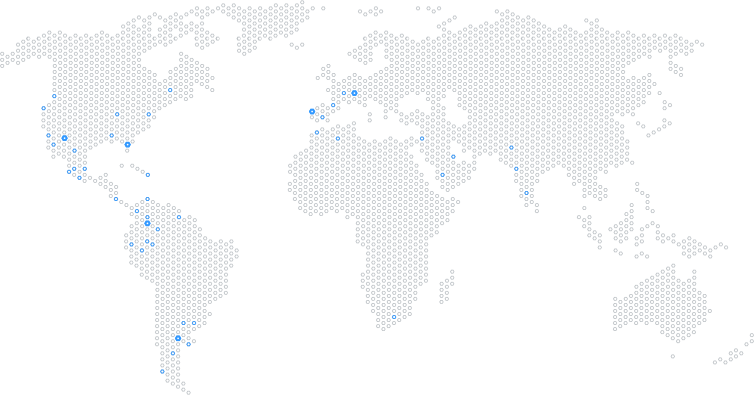
 Argentina
  Australia
  Brazil
  Bulgaria
  Canada
  Chile
Chile  Colombia
  India
India  Mexico
  Peru
Peru  Poland
  Romania
  Singapore
  Sri Lanka
  Switzerland
  Ukraine
  USA
USA  Vietnam
 We Are a Collaborative of Experts in The Software Development Industry
At Global Software Companies, we bring together a global collective of industry professionals, researchers, and analysts with deep experience in software development, team building, and engineering operations.
Our goal is to make software outsourcing smarter, leaner, and more transparent. We’ve partnered with experts across Latin America, Eastern Europe, Asia, and beyond to share insights and help businesses navigate the complex world of software development partnerships.
We believe in three core principles:
- Accessibility: Making it easier for companies to connect with vetted development partners.
- Trust: Promoting transparency and accountability across the software outsourcing ecosystem.
- Efficiency: Cutting through the excess and helping you identify companies that deliver real value without bloated overhead.
Whether you’re launching a startup or managing a global IT strategy, we’re here to simplify your vendor selection process and empower you to build with confidence.
 Alexander Lim
  Daniel Grygoryev
  Franceska Fajhner
  Jovana Tomin
  Karl Kjer
  Mina Stojkovic
  Paul Rose
  Victor James