Find the Best UI/UX Design Software Development Companies in 2026 — in Under 60 Seconds

Compare 100s of software development companies.

Evaluate the pros and cons of each company based on your requirements.

Results based on 700+ hours of industry research.

Best UI/UX Design Software Companies in 2026

1CI&T

2Thoughtworks

3N-iX

4Globant

5Net Solutions

6Rootstrap

7STX Next

8Cleveroad

9Brainhub

10Andersen Inc.

11Capital Numbers

12Hexacta

1310 Pearls

14SteelKiwi

15Mentor Mate

16Elinext
UI/UX Design Companies: A Buyer's Guide
The global UX services market is valued at $6.4 billion in 2025 and is projected to reach $77 billion by 2034 at a 31.2% CAGR, according to Fortune Business Insights. That growth rate reflects a market reality backed by McKinsey research showing design-led companies significantly outperform their peers on revenue and shareholder returns. UX is no longer a finishing touch. It's a revenue driver.
This guide evaluates UI/UX design companies using proprietary data from 1,593 providers across 64 countries, salary benchmarks from 16,704 respondents, and service capability analysis. The data reveals a market where India and the US nearly tie for provider count, smaller agencies consistently rate higher than large ones, and eCommerce dominates as the primary industry vertical.
The Business Case for UX Design Investment
Before evaluating providers, buyers need to understand what the return on UX investment actually looks like. Three independent research programs provide the evidence:
McKinsey's Design Index tracked 300+ companies over five years and found design leaders delivered 32% higher revenue growth, 56% higher shareholder returns, twice the speed of new product launches, and 41% higher market capitalization within their sectors.
Forrester's Customer Experience Index, widely cited across design industry analyses, found top-quartile CX companies grow revenue 1.7x faster than laggards, with customer lifetime value increasing 1.9x and customer acquisition costs dropping 25% through higher referral rates.
Adobe's S&P 500 analysis, as documented in design industry research, showed design-centric companies outperformed the S&P 500 by 228% over 10 years, with consistent 10% higher revenue year-over-year and 65% higher share price appreciation.
These aren't marginal gains. For organizations evaluating software outsourcing costs, UX design investment has a documented business case that few other service categories can match with this level of evidence.
Market Demand for UI/UX Design
Our ongoing salary research using Stack Overflow Developer Survey data shows UX/UI designer compensation growing 36.2% since 2018 (16,704 cumulative respondents), among the faster growth rates of any design-related specialization.
| Country | 2018 Median | 2022 Median | Recent | Notes |
|---|---|---|---|---|
| Global | $51,403 | $62,820 | $70,000 (2024, n=39) | +36.2% growth, directional recent data |
| United States | — | $120,000 (n=483) | — | 2022 is reliable; post-2022 samples too small to report |
| United Kingdom | — | $63,320 (n=132) | $74,483 (2023, n=8) | Growing, small recent sample |
| Germany | — | $57,588 (n=147) | — | Only 2022 data available |
| Canada | — | $76,522 (n=82) | — | Only 2022 data available |
| India | — | $15,478 (n=76) | — | Only 2022 data available |
| Poland | — | $41,628 (n=53) | — | Only 2022 data available |
Source: Stack Overflow Developer Survey 2018-2024, 16,704 respondents. Post-2022 samples are small for most countries — we're continuing to track this data as sample sizes grow.
The 2022 US median of $120,000 for UX/UI designers (n=483, a reliable sample) provides the most defensible salary benchmark. The UX design market itself reached $11.4 billion in 2025 and is growing at 14.67% CAGR to $22.6 billion by 2030 (Mordor Intelligence), confirming sustained demand for these skills.
The chart uses 2018-2022 data where sample sizes are adequate (1,830-4,611 respondents per year). The 2022 jump from $53K to $63K mirrors the post-pandemic surge in digital product investment seen across all design categories.
The UI/UX Design Provider Market
Our analysis of 1,593 UI/UX design providers across 64 countries shows a market nearly evenly split between India and the United States.
India leads at 514 providers (32.3%) versus 496 in the US (31.1%), a gap of just 18 firms. Poland (72), Ukraine (67), and the UK (60) form a competitive second tier providing European time zone options.
Rate benchmarks across the provider market:
| Rate Tier | Median Rate | Market Segment |
|---|---|---|
| Budget | $20-$29/hr | India, Pakistan, Vietnam — wireframing, UI execution |
| Mid-market | $30-$49/hr | US (median), Ukraine, Canada — full-service UX/UI |
| Premium | $50-$99/hr | UK, Poland, Australia — research-led, enterprise UX |
| Top-tier | $100-$200+/hr | Specialized UX consultancies, design system architects |
8% of providers are design-focused specialists (3 or fewer services), meaning roughly 127 firms concentrate on UX/UI rather than bundling it with 10+ other offerings. The median provider offers 9 services. For projects where design quality is the primary concern, filtering for providers with fewer service lines increases the likelihood of finding dedicated UX/UI depth.
Budget accessibility: 30.6% accept projects under $5,000 (enough for UX audits, single-screen redesigns, or usability reviews). 26.4% start at $5K-$10K. Full UX/UI redesign engagements ($10K-$50K) are served by 22%. Enterprise design systems and ongoing partnerships ($50K+) narrow to 5% of providers.
Provider Size and Maturity
Among the 1,560 providers with disclosed employee counts:
| Company Size | Providers | % | Median Clutch Rating |
|---|---|---|---|
| 2-9 employees | 99 | 6.3% | 5.0 |
| 10-49 employees | 625 | 40.1% | 4.9 |
| 50-249 employees | 663 | 42.5% | 4.9 |
| 250-999 employees | 135 | 8.7% | 4.9 |
| 1,000+ employees | 32 | 2.1% | 4.8 |
Micro-agencies (2-9 employees) hit a 5.0 median Clutch rating. For UX/UI work, this pattern is particularly relevant: design quality depends on senior individual talent, and small studios built around experienced designers often deliver more cohesive work than large agencies where design is one department among many.
The market is relatively young and still attracting new entrants: 59.3% of providers were founded between 2011 and 2020, and 11.5% are post-2021 — among the higher recent-entry rates across service categories, behind web development (12.2%) and reflecting growing demand for design services. Staff augmentation shows the highest rate (15.8%) but uses an unfiltered dataset.
Industries Driving UI/UX Design Demand
Our provider data shows where UX/UI expertise concentrates:
| Industry | % of UX/UI Providers | Why UX Matters Here |
|---|---|---|
| eCommerce | 79% | Checkout conversion, product discovery, mobile-first shopping |
| Medical / Healthcare | 71% | Patient portals, telehealth accessibility, HIPAA-compliant interfaces |
| Media | 61% | Content consumption, navigation patterns, engagement optimization |
| Financial Services | 52% | Banking apps, trading interfaces, onboarding flows |
| Education | 48% | Learning platforms, student engagement, adaptive content delivery |
| Hospitality | 43% | Booking flows, loyalty programs, guest experience |
| Retail | 41% | Omnichannel interfaces, in-store digital, loyalty apps |
E-commerce development dominates at 79%. Healthcare at 71% demands providers with accessibility expertise (WCAG compliance) and familiarity with regulated data environments. Financial services at 52% requires secure authentication patterns and PCI-DSS awareness. If your product handles sensitive user data, cybersecurity capability should factor into UX/UI partner selection alongside design skills.
What to Look For in a UI/UX Design Provider
Evaluating UX/UI providers requires assessing technical capability, process rigor, accessibility compliance, and measurable outcome history.
Technical Capabilities
Our technology taxonomy tracks development frameworks rather than design tools. For UX/UI evaluation, verify proficiency in Figma, Sketch, or your preferred design platform directly. On the development side, our data shows what providers build with:
| Technology | % of UX/UI Providers | Relevance |
|---|---|---|
| React | 60% | Component-based UI development, design system implementation |
| iOS Native | 58% | Native iOS design patterns and implementation |
| Android Native | 54% | Material Design implementation |
| Cross-platform | 52% | React Native/Flutter — single design for both platforms |
| Python | 36% | Prototyping tools, backend for design infrastructure |
| AWS | 34% | Hosting design systems, A/B testing infrastructure |
React dominance at 60% reflects the industry's convergence on component-based UI development. Providers proficient in React can build design systems that translate directly to code, reducing the design-development handoff gap. For web development projects that include a UX/UI component, the 79% service overlap means most providers can handle implementation alongside design.
The cross-service coverage extends further: 82% offer mobile app development and 68% offer custom software development, meaning most UX/UI providers can carry design through to engineering if needed.
Evaluation Criteria
Four signals separate UX/UI providers who deliver measurable outcomes from those who deliver polished mockups:
First, examine portfolio process documentation. The best portfolios show research findings, wireframes, iteration history, and measurable outcomes alongside final screens. A portfolio of only beautiful finished designs tells you about visual skill but nothing about whether the provider understands user problems. Apply a 15-minute test: if you can't find case studies with process documentation and business metrics within 15 minutes, move on.
Second, verify design-to-development handoff. UX/UI design fails when it doesn't translate to engineering. Ask how the provider packages deliverables: do they provide annotated specs, component libraries, and interaction documentation? Do they use design tokens? Do they participate in engineering review? When building dedicated teams, the handoff process between design and development directly determines product quality.
Third, check accessibility expertise. WCAG 2.1 AA compliance is increasingly a legal requirement rather than just best practice in the US, EU, and UK. Ask whether the provider designs for accessibility from the start or retrofits it later. Accessible-first design is a fundamentally different process than accessibility-as-afterthought.
Fourth, assess measurable impact history. Conversion improvements, task completion rate changes, user satisfaction scores, time-on-task reductions. Providers who track and report business metrics demonstrate accountability. Those who can't cite specific outcomes from past projects may be execution shops rather than strategic partners.
Red Flags
Watch for these warning signs:
- Portfolio shows only final screens with no process, research, or metrics
- Provider can't articulate how they measure design impact
- No accessibility expertise or WCAG awareness
- Handoff process is "we send a Figma link" with no documentation or developer collaboration
- Design process starts with visual mockups rather than research or user flows
UI/UX Design Provider Ratings by Country
Among the 807 providers (51%) with verified Clutch ratings:
| Country | Providers | Mean Clutch Rating | Median Rate |
|---|---|---|---|
| Vietnam | 27 | 4.94 | $20-$29/hr |
| Australia | 25 | 4.93 | $30-$49/hr |
| Ukraine | 67 | 4.92 | $30-$49/hr |
| Pakistan | 46 | 4.92 | $20-$29/hr |
| United Kingdom | 60 | 4.91 | $50-$99/hr |
| Poland | 72 | 4.90 | $50-$99/hr |
| Canada | 43 | 4.89 | $50-$99/hr |
| United States | 496 | 4.87 | $30-$49/hr |
| India | 514 | 4.85 | $20-$29/hr |
Vietnam leads quality-to-cost at 4.94 and $20-29/hr. Ukraine at 4.92 and $30-49/hr offers a strong mid-market option with European time zone alignment. India has the most providers (514) but the lowest average rating (4.85) — the wide quality range makes portfolio evaluation especially important.
For UX/UI specifically, ratings capture client satisfaction with the design process but not the objective quality of the design output. Use ratings to filter out low performers, then evaluate on portfolio quality and the criteria above. For regional outsourcing context, see our guides on outsourcing software development and the pros and cons of outsourcing.
How We Rank UI/UX Design Companies
Our GSC Score synthesizes review quality (40%), technical capability (30%), and domain authority (30%) across 1,593 UI/UX design providers. Rankings update quarterly across leading software development companies. For a complete vendor evaluation framework, see our guide on how to choose a software development company.
Frequently Asked Questions
How much does UI/UX design cost?
Based on our provider data, 30.6% accept projects under $5,000 for UX audits and usability reviews. Full UX/UI redesign engagements ($10K-$50K) are served by 22% of providers. Enterprise design systems and ongoing partnerships ($50K+) narrow to 5%. Rates range from $20/hr (India, Vietnam) to $200+/hr (specialized consultancies), with a global median of $30-$49/hr. UX/UI designer salaries averaged $62,820 globally in 2022 (our most recent large-sample year), with the US at $120,000.
What skills should a UI/UX design provider have?
Interaction design, visual design, user research, information architecture, prototyping, usability testing, design systems development, and accessibility compliance. For product design engagements that go beyond UX/UI execution into strategy and discovery, verify research methodology and product thinking capability separately.
Should I outsource UI/UX design or build in-house?
UX/UI designer salaries are significant (US median: $120,000 in 2022) and the market is growing at 36.2%. 82% of UX/UI providers also offer mobile development and 68% offer custom software, meaning outsourcing gives you design integrated with engineering. Build in-house when design is a core product differentiator you'll iterate continuously. Outsource for defined phases, or use augmentation models to add senior design capacity without permanent headcount.
How long does a typical UI/UX design project take?
UX audit and recommendations: 2-4 weeks. Single-feature redesign: 4-8 weeks. Full product UX/UI redesign: 3-6 months. Design system creation: 4-8 months. Timeline depends heavily on the depth of research required, number of user flows, and complexity of the interaction model.
Which industries invest most in UI/UX design?
eCommerce leads our data at 79%, followed by healthcare (71%) and media (61%). Industries where the user interface IS the product (eCommerce checkout, banking apps, learning platforms) invest most. Healthcare is driven by accessibility requirements and regulatory compliance as much as by competitive differentiation. For managing remote development teams that include designers, ensure the design-development collaboration process works across time zones.
Sources
[1] Fortune Business Insights — UX Services Market — Market size $6.4B (2025), 31.2% CAGR to $77B by 2034.
[2] McKinsey — The Business Value of Design — 300+ companies, 5 years. 32% higher revenue growth, 56% higher shareholder returns for design leaders.
[3] Mordor Intelligence — UX Design Market — Market size $11.4B (2025), 14.67% CAGR to $22.6B by 2030.
[4] Stack Overflow Developer Survey 2018-2024 — 16,704 respondents in UX/UI design category. Salary data by country and year. Licensed ODbL v1.0.
[5] Forrester Customer Experience Index — Top-quartile CX companies grow revenue 1.7x faster, CLV increases 1.9x. Cited via industry analysis.
[6] Adobe S&P 500 Analysis — Design-centric companies outperformed S&P 500 by 228% over 10 years. Cited via industry analysis.
[7] Internal analysis of 4,145 software development company profiles aggregated from Clutch, TechReviewer, and proprietary scoring datasets (January 2026 snapshot). UI/UX Design service data based on 1,593 providers across 64 countries.
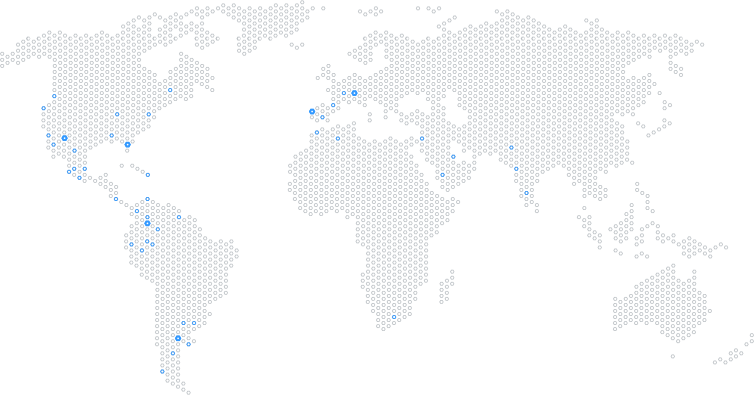
 Argentina
  Australia
  Brazil
  Bulgaria
  Canada
  Chile
Chile  Colombia
  India
India  Mexico
  Peru
Peru  Poland
  Romania
  Singapore
  Sri Lanka
  Switzerland
  Ukraine
  USA
USA  Vietnam
 We Are a Collaborative of Experts in The Software Development Industry
At Global Software Companies, we bring together a global collective of industry professionals, researchers, and analysts with deep experience in software development, team building, and engineering operations.
Our goal is to make software outsourcing smarter, leaner, and more transparent. We’ve partnered with experts across Latin America, Eastern Europe, Asia, and beyond to share insights and help businesses navigate the complex world of software development partnerships.
We believe in three core principles:
- Accessibility: Making it easier for companies to connect with vetted development partners.
- Trust: Promoting transparency and accountability across the software outsourcing ecosystem.
- Efficiency: Cutting through the excess and helping you identify companies that deliver real value without bloated overhead.
Whether you’re launching a startup or managing a global IT strategy, we’re here to simplify your vendor selection process and empower you to build with confidence.
 Alexander Lim
  Daniel Grygoryev
  Franceska Fajhner
  Jovana Tomin
  Karl Kjer
  Mina Stojkovic
  Paul Rose
  Victor James